Risks of DIY Tree Removal: What Can Go Wrong
Last Updated: October 23, 2026
Quick Summary
DIY tree removal risks serious injury from chainsaws and ladder falls, plus unpredictable fall direction caused by hidden decay, lean and wind. It can also damage roofs, fences and vehicles, and any work near power lines is lethal and regulated. Hire an arborist for any tree over about 3 metres or within falling distance of structures.
- Never cut above shoulder height with a chainsaw, because a kickback at head height causes serious facial and neck injuries.
- Most ladder accidents happen when the ladder leans against a branch that gives way or sits on soft ground.
- Deadwood is a silent hazard: a limb that looks solid can be hollow and drop without warning.
- Treat any tree over about 3 metres, or one leaning toward a target, as a professional rigging job.
- Keep everyone at least 10 metres clear of a downed line, and further if the ground is wet.
Table of Contents
- Why DIY Tree Removal Goes Wrong So Often
- The Injury and Fatality Risks of Cutting Trees Yourself
- Falling Branches and the Unpredictable Direction of a Tree
- Tree Removal Property Damage: Roofs, Fences and Vehicles
- Tree Removal Near Power Lines: A Risk You Cannot Manage Alone
- When to Hire an Arborist for Tree Removal
- Permits, Protected Trees and What Happens After an Accident
- Frequently Asked Questions
Why DIY Tree Removal Goes Wrong So Often
The risks of DIY tree removal start with a simple truth: a tree falls where physics, decay and gravity decide, not where you want it to.
At Trees Hedge and Stump Removal, we clean up the aftermath more often than most people realise: a homeowner with a chainsaw, a ladder and good intentions, then a fence, a roof or a person on the receiving end.
DIY tree removal is the practice of felling, cutting up or dismantling a tree on your own property without a trained arborist. It sounds straightforward.
Most guides get this wrong: it is a hazard assessment problem, not a cutting problem.
Three things make it fail:
- You cannot see the defects. Decay, rot and hollow cores hide inside the trunk until the load shifts.
- You cannot predict the fall. Lean, wind, weight distribution and hinge quality all pull the tree off course.
- You cannot absorb the consequences. A mistake here damages property or people, not just a lawn.
The Injury and Fatality Risks of Cutting Trees Yourself
Personal injury is the headline risk: tree work combines heavy loads, sharp tools, height and unstable structures in a single job. Most injuries are cutting-tool injuries or falls.
Chainsaw and Cutting-Tool Injuries
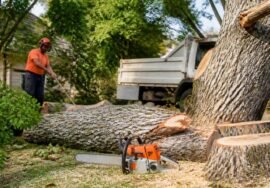
A chainsaw is the most dangerous tool most homeowners will ever pick up. It cuts fast, it kicks back, and it does not stop for bone.
Common mistakes we see:
- Cutting overhead with no clear escape route
- Using a dull or faulty chain that grabs and kicks
- Working without chainsaw chaps, a helmet or eye protection
Kickback is the big one: the bar tip catches, the saw jumps back, and there is no time to react.
Never cut above shoulder height with a chainsaw. A kickback at head height is how serious facial and neck injuries happen, and a dull chain makes it far more likely.
Ladder Falls and Climbing Accidents
Ladders and trees do not mix: branches shift, sawdust coats the rungs, and a running chainsaw needs two hands. Most ladder accidents happen because the ladder is leaning against a branch that gives way, set on soft or sloping ground, too short, or used one-handed while the other hand holds a saw. Professional arborists climb with ropes, harnesses and rigging designed to arrest a fall.
Falling Branches and the Unpredictable Direction of a Tree
Falling branches and unpredictable fall direction cause more property damage than any other factor.
What makes the fall direction unpredictable:
- Lean and weight bias. A tree leaning toward a house usually wants to go there.
- Deadwood and decay. Rotten limbs snap without warning, often mid-cut.
- Wind and surrounding vegetation. A light breeze at ground level can be stronger at canopy height.
Deadwood is the silent hazard: a limb that looks solid can be hollow inside, and when it lets go it drops straight down with no warning.
You can plan a fall direction perfectly and still lose the tree to a defect you could not see from the ground.
Tree Removal Property Damage: Roofs, Fences and Vehicles
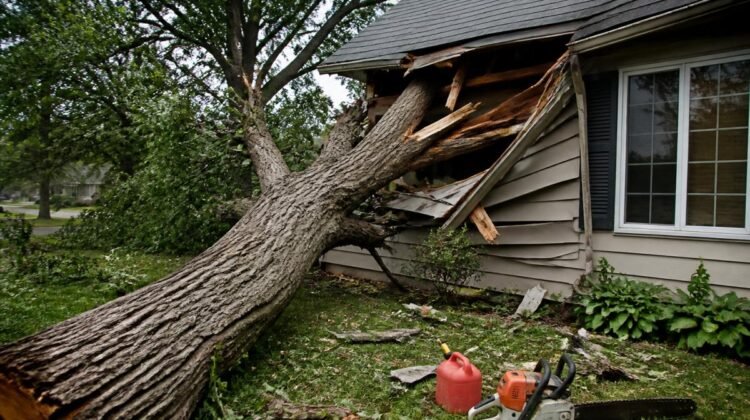
Tree removal property damage adds up fast: a single misjudged drop can take out a fence, crush a shed or put a limb through a roof.
The usual casualties:
- Roof tiles, gutters and fascias
- Fences and retaining walls
- Parked cars and trailers
Structural damage is the expensive one. A limb through a roof lets water in, and water damage spreads well beyond the impact point.
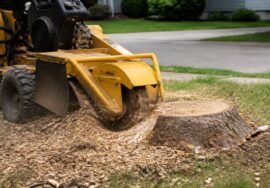
Then there is cleanup: a felled tree leaves a stump, a debris pile and compacted soil, and stump grinding and debris removal are separate jobs many DIY attempts leave half-finished.
Before any tree work, photograph your fence, roof and driveway. If something goes wrong, you will need a clear before-and-after record for any claim.
Tree Removal Near Power Lines: A Risk You Cannot Manage Alone
Tree removal near power lines is never a DIY job. Overhead lines carry lethal voltage, and contact can happen through a branch, a ladder or a wet tool.
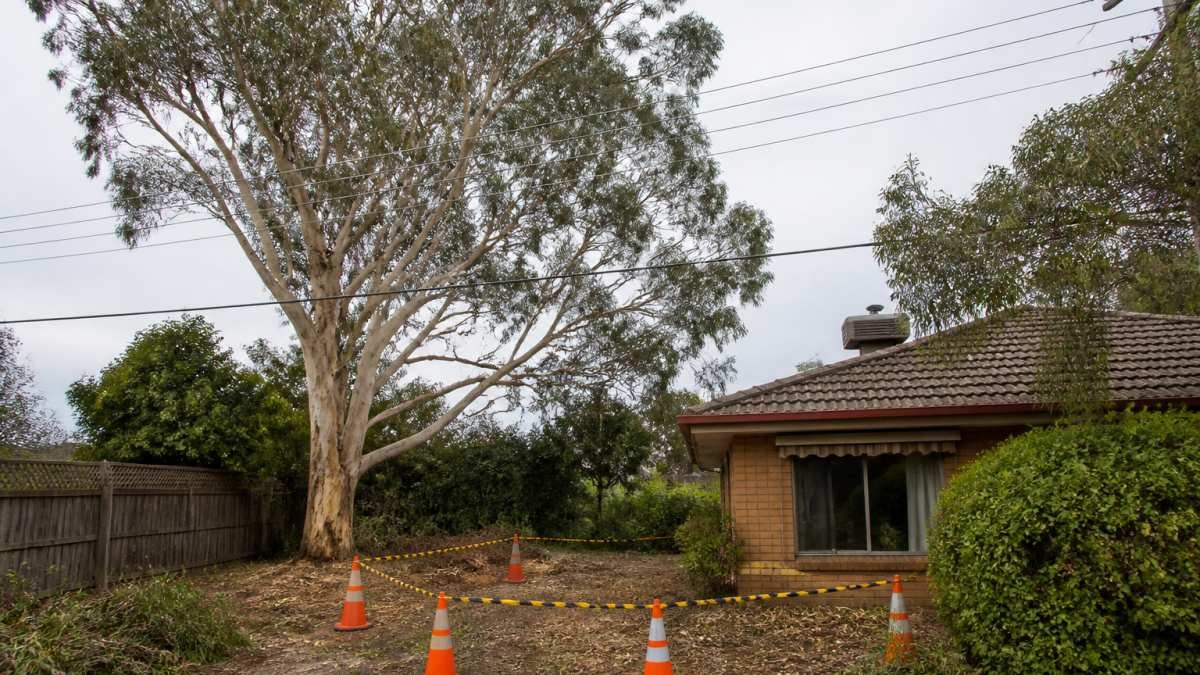
The danger is bigger than it looks:
- Branches conduct. A limb touching a live line can energise the whole tree.
- Fall distance matters. A tree can contact lines on the way down, even if it starts clear.
- Ladders bridge the gap. Metal ladders near lines are a direct path to earth.
Work near live lines is regulated and only authorised people can do it. If a tree is anywhere near overhead lines, stop: this is a job for the network operator and a qualified arborist together.
When to Hire an Arborist for Tree Removal
Hire an arborist when the tree is tall, near structures, near power lines, or showing signs of decay. But ‘tall’ and ‘near’ are vague, so here is a more concrete way to decide.
Stop-Work Criteria: When DIY Is Off the Table
Treat any one of these as a hard stop, not a ‘be careful’.
- Height. Any tree over about 3 metres, or any limb you cannot control with one hand from the ground, is beyond safe DIY felling. Above that height, the fall zone, the weight and the consequences all scale up faster than your ability to manage them.
- Lean. A tree leaning more than a few degrees toward a target, a roof, fence, car, shed or neighbour’s boundary, is a rigging job. You cannot pull a leaning tree back against its own weight with a rope and a helper.
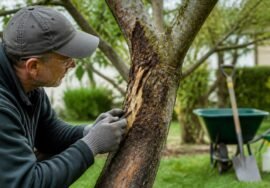
- Decay. A hollow trunk, fungal fruiting bodies at the base, cracks, seams or a cavity you can put a finger into means the tree’s structural integrity is already compromised. Cutting into it can trigger a collapse you cannot predict.
Tick even one box and the job is a professional one.
Safe Alternatives to Full Removal
Removal is not always the only answer. Before you commit to felling, ask whether one of these would solve the actual problem:
- Arborist assessment. A qualified arborist can identify whether the tree is structurally sound, what is causing the issue (shading, root damage, dropping limbs) and whether it can be retained safely.
- Selective pruning. Deadwooding, thinning and crown reduction can remove the hazard, the dead limb over the roof, the low branch over the driveway, without losing the tree.
- Deadwood removal. If the risk is falling deadwood rather than the whole tree, targeted deadwood removal is far cheaper and safer than removal.
Most DIY guides skip this: the question is not always ‘how do I remove this tree safely?’ but ‘do I need to remove it at all?’
What an Arborist Brings That DIY Cannot
An arborist brings what DIY cannot:
- Formal training and hazard assessment
- Rigging and controlled lowering of limbs
- Personal protective equipment and insurance
At Trees Hedge and Stump Removal, our arborists are qualified and insured, and we run a 24-hour emergency service for storm damage.
A Simple Decision Framework for DIY Versus Professional
Use this framework before you touch a saw. If you tick any box in the ‘call a professional’ column, stop.
| Factor | Safe to consider DIY | Call a professional |
|---|---|---|
| Tree height | Under 3 metres, thin limbs | Over 3 metres, or any large limb |
| Distance to structures | Well clear of everything | Within falling distance of a roof, fence or car |
| Power lines | None nearby | Any overhead line in range |
| Tree health | Solid, no visible decay | Deadwood, rot, cracks or hollow trunk |
| Lean | Straight and balanced | Leaning toward a target |
| Access | Flat, open ground | Sloping, tight or obstructed |
| Your equipment | Hand tools, full PPE | Chainsaw at height or climbing |
| Your experience | Confident with small pruning | No formal felling training |
If you are unsure, treat it as a professional job. The downside of guessing wrong is not worth it.
Permits, Protected Trees and What Happens After an Accident
Permits and protected trees catch homeowners out, and the consequences land after the work is done. Many councils require approval before removing or heavily pruning a tree, and some trees are protected regardless of size.
Checking Permits and Protected Trees Before You Cut
What to check before any removal:
- Whether your council requires a permit for the tree
- Whether the tree is on a significant tree register
- Whether it is native vegetation with protection rules
Removing a protected tree without approval can lead to fines and orders to replant (Protected vegetation permits). Rules vary by council and state, so check with your local council before any work begins, not after.
Emergency Response After an Accident or Unexpected Fall
Those first few minutes after something goes wrong matter more than anything else.
If someone is injured:
- Call emergency services immediately. Do not wait to assess whether it is ‘serious enough’.
- Do not move an injured person unless they are in immediate danger, for example, under a still-hanging limb or near a live line.
- Control bleeding with direct pressure if you are trained to do so, and keep the person still and warm until help arrives.
If a line is down or a tree is touching a line:
- Assume every downed line is live, even if the power looks off (Electrical emergencies).
- Keep everyone at least 10 metres clear, and further if the ground is wet.
- Do not touch the tree, the line, or anything in contact with them, including fences, tools and vehicles.
If a limb or tree has fallen but no one is hurt:
- Keep people and pets out of the area, a partially fallen tree or a hung-up limb can drop without warning.
- Do not cut anything that is under tension or supporting weight. A limb pinned under a fallen trunk can spring back when cut.
- Photograph the scene before anything is moved, for any insurance claim.
Never approach a tree that is resting on a structure, a vehicle or a power line. The load path is unpredictable, and cutting the wrong point can bring the whole thing down.
Liability and Financial Consequences
Then there is the accident itself: if a limb damages a neighbour’s property you may be liable for the repair, and if someone is injured on your land the fallout can be far worse.
- Neighbour’s property. If your tree or your work damages a neighbour’s fence, roof or car, you may be responsible for making it good. Document the condition of shared boundaries before any work.
- Injury on your land. If a helper or bystander is injured during DIY work, the consequences can extend well beyond the repair bill.
- Policy terms. Check what your home and contents policy actually covers before work begins. Many policies exclude damage from tree work you do yourself, and some exclude tree removal entirely.
The cheapest tree job is the one done right the first time: permits, liability and cleanup usually outweigh any saving from doing it yourself.
Frequently Asked Questions
What can go wrong when removing a tree yourself?
The most common failures are a tree falling the wrong way, a chainsaw kickback injury, a ladder slipping, or a limb dropping onto a roof, fence or car. Deadwood and rot inside the trunk can also cause a tree to split mid-cut without warning. Because DIY tree removal gives you no margin for error, a single misjudged back cut can turn a routine job into a serious injury or a damaged structure. If the tree is close to a building, a fence line or overhead wires, the risk rises sharply.
Can you remove a tree near power lines yourself?
No. Tree removal near power lines is work that should only be handled by qualified professionals working with the electricity distributor. Contact with live conductors can be fatal, and the risk is not always visible because a branch can bridge the gap before it touches the line. Even pruning within the clearance zone usually requires approval and authorised contractors. If a tree is touching or close to lines, keep clear, warn others and call the distributor or a qualified arborist rather than attempting tree cutting.
When should you call an arborist to remove a tree?
Call an arborist when the tree is taller than about 3 metres and within falling distance of a house, shed, fence or driveway, when it leans or shows deadwood, decay or fungal growth, when it sits near power lines, or when you cannot confirm the tree is not protected. A qualified arborist can assess tree lean, structural failure risk and safe removal options. For anything beyond a small, isolated tree in open ground, professional tree removal is the cheaper and safer choice.
How can a falling tree damage a house, driveway or fence?
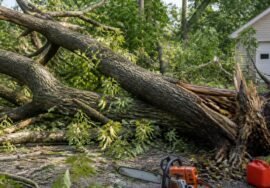
A falling tree can crush roof framing, crack brickwork, buckle a fence line, lift and crack a concrete driveway, and write off a parked vehicle. Root plates and heavy limbs also damage underground services and lawns during the drop and cleanup. Tree removal property damage often costs far more to repair than the removal itself, and if the tree was protected or the work was unapproved, you may also face fines. Insurance may not cover careless DIY work, so check before you cut.
Tree work punishes guesswork, and the stakes are your property, your safety and your liability. If a tree is tall, near a structure, near power lines or showing decay, the smart move is to hand it to a qualified arborist. At Trees Hedge and Stump Removal, our fully qualified and insured local arborists handle safe removal, pruning and stump grinding, backed by 24-hour emergency service and competitive pricing. Get a free quote from Trees Hedge and Stump Removal and take the risk off your hands.